

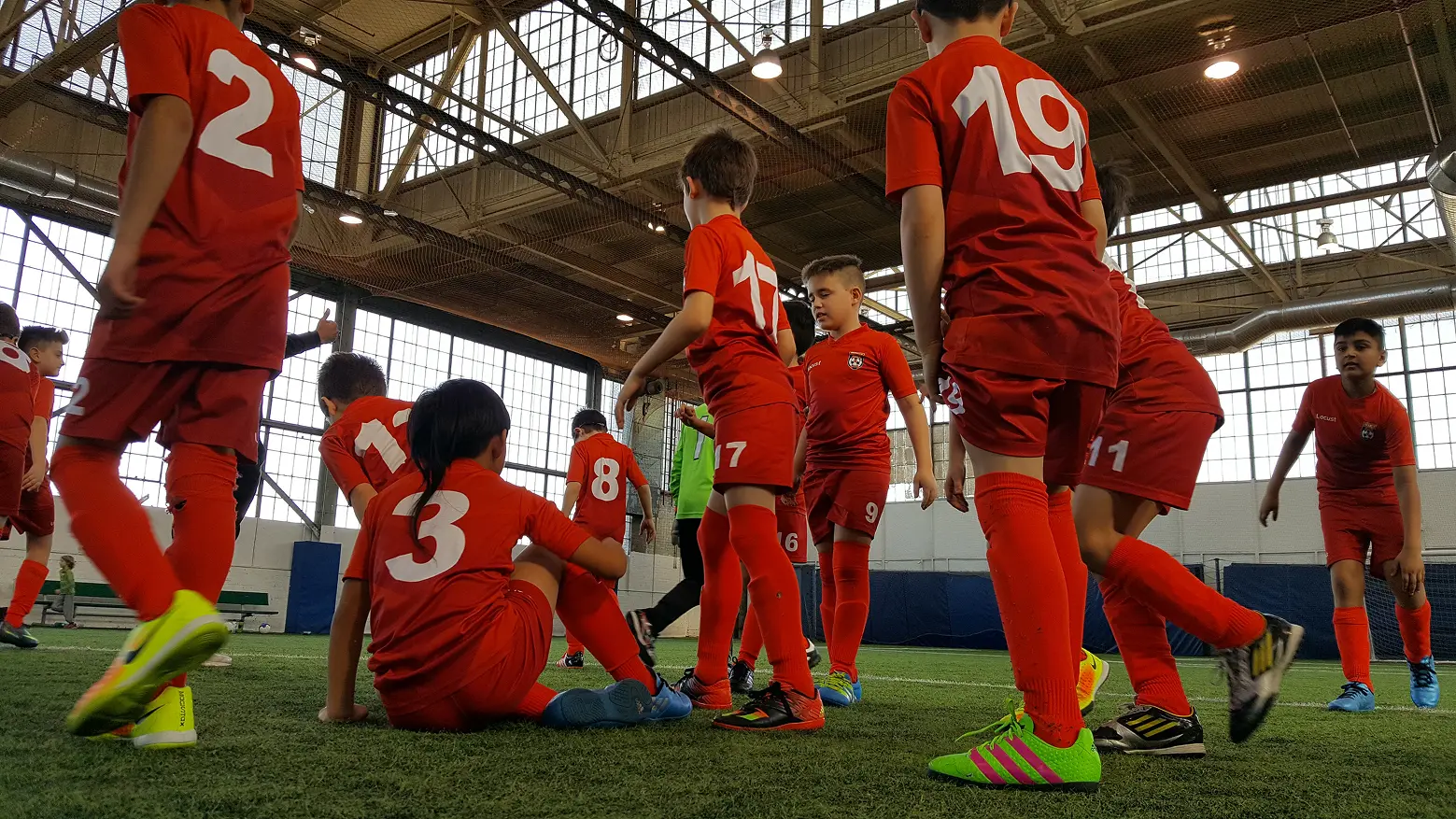
Futsal is its own game
Futsal is sometimes described as indoor soccer, but that description leaves out what makes it different.
The recognized game is normally played five against five, including goalkeepers, on a hard court marked by boundary lines. There are no walls to keep the ball in play. It uses a smaller, low-bounce ball and allows rolling substitutions.
These features create a fast game in a compact space. Players are repeatedly asked to receive, pass, dribble, defend and move. There is little time to stand and watch because the next decision arrives quickly.
Canada Soccer describes futsal as a fast-paced indoor sport played on a small hard court with five players per side, a low-bounce ball and its own laws. It is not a winter version of outdoor soccer with the same rules.
More involvement in less space
A smaller playing area brings players closer to the ball and to one another. Pressure arrives quickly, passing lanes change rapidly and poor control is more difficult to hide.
This can support development because players experience many game situations in a short period. They must scan, create an angle, protect the ball and decide whether to pass, dribble or shoot.
The format does not develop players automatically. Coaching and organization still matter. A player can repeat poor habits in any game. When sessions have clear objectives and suitable guidance, futsal creates a useful environment for learning.
Close control becomes essential
The low-bounce ball and hard surface reward accurate touches. Players cannot rely on the ball rolling into open grass or bouncing away from pressure.
Receiving with control becomes important because the next opponent may be only a few steps away. Players learn to use different surfaces of the foot, shield the ball and change direction in tight areas.
These skills can transfer to outdoor soccer, especially when a player receives in crowded midfield spaces or near the penalty area. The outdoor game offers more space, but the need for a useful first touch remains.
Players learn to think faster
Futsal places technical skill and decision-making together.
A player may see an option, but the pass must be delivered accurately and at the right time. Holding the ball for an extra moment may close the passing lane. Moving after a pass may create the next opening.
Because possession can change quickly, players also learn transitions. Everyone has attacking and defending responsibilities. Losing the ball requires an immediate response, and winning it creates a short opportunity before the opponent reorganizes.
These repeated moments can help players become more alert and independent. Coaches should guide the principles while allowing the game to teach.
Futsal is useful beyond outdoor preparation
Futsal can support outdoor soccer development, but it should not be treated only as a training exercise.
It has its own techniques, tactics and rhythm. Players can learn to enjoy and understand futsal as a sport in its own right. Respecting those differences leads to a better program than placing outdoor soccer in a gym and calling it futsal.
Age-appropriate groups are important. Younger players may focus on comfort with the ball, movement and simple decisions. Older or more experienced groups can work with greater speed, pressure and tactical detail.
The number of players in each session also matters. Overcrowding reduces involvement, which removes one of futsal’s main benefits.
What Hearts is developing
North York Hearts Soccer Club is in the early stages of developing a gym-based futsal program for different youth age groups.
Program details, including gym locations, schedules, age divisions, fees and registration, must be confirmed before they are published. Families should rely on official club updates for final information.
The opportunity is promising. Futsal could give Hearts house league and competitive players another way to stay active, improve close control and continue learning when outdoor conditions change.
The strongest version of the program will preserve what makes futsal valuable: small groups, frequent involvement, appropriate coaching and a clear difference from boarded indoor soccer.
For parents, the appeal is straightforward. Children receive a fast and challenging game in which they are rarely far from the action. For players, every touch asks a question. Control the ball, see the space and make the next decision.
What parents should expect from a youth program
A youth futsal program should explain how groups are formed, what footwear and equipment are required, and how sessions balance instruction with games. Players need court shoes, shin guards and a properly sized futsal ball supplied or approved by the program.
Parents should also expect age-appropriate rules. Younger groups may use simplified restarts or shorter games while learning the basic format. Any modifications should support learning without removing the qualities that make futsal distinct.
Safety requires attention to the gym surface, goals, surrounding space and player numbers. A well-run program gives children room to play at speed while maintaining clear boundaries and supervision.
Consistent attendance also helps. Futsal concepts build over time, and players benefit when coaches can progress from basic control and movement into more demanding game situations.
Next step
Follow North York Hearts Soccer Club for confirmed futsal program details and future registration information.