

When should young players try goalkeeping—and when should they make it their position?
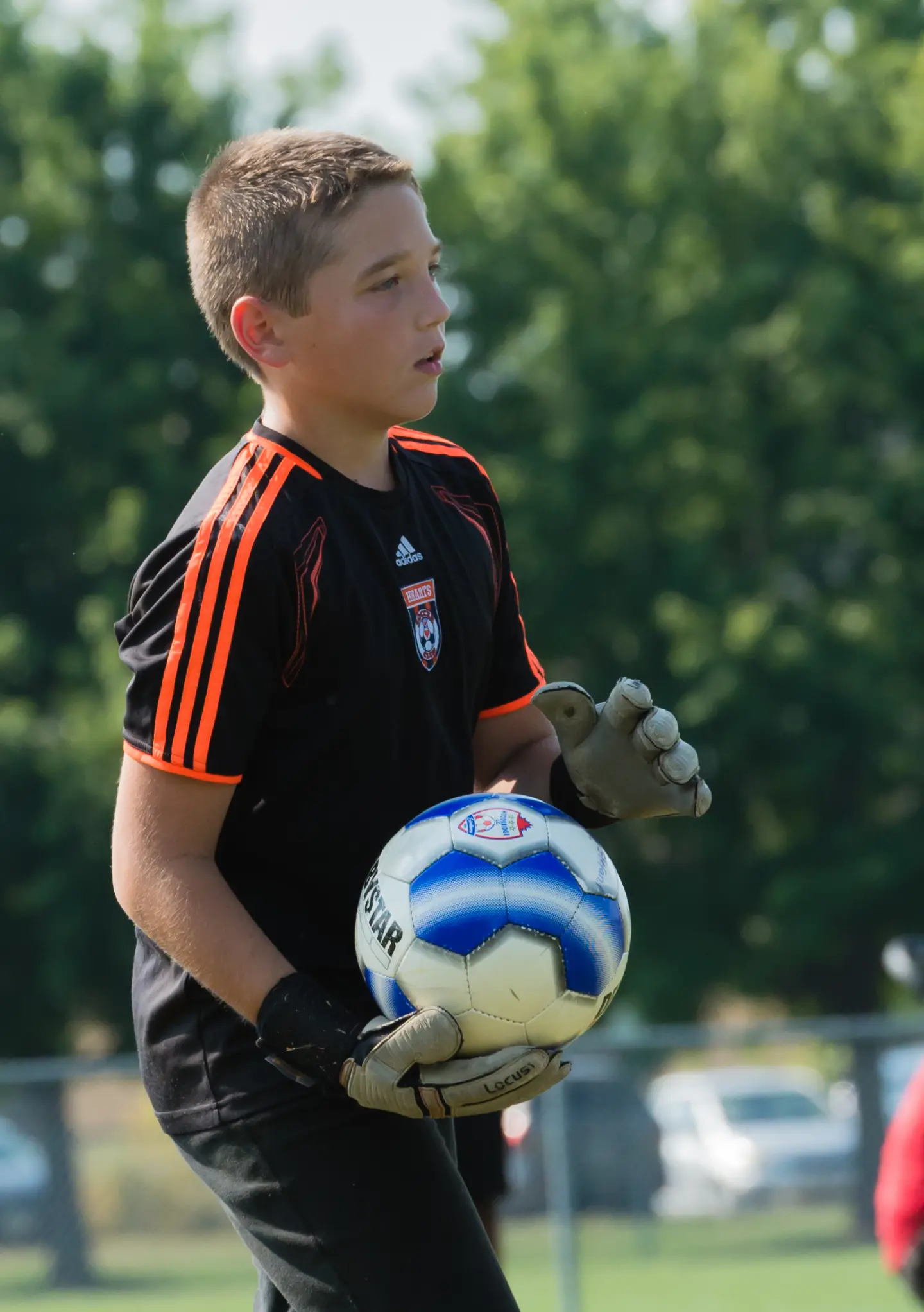
Look at the photograph.
A young North York Hearts goalkeeper holds the ball in gloved hands, eyes lifted towards something beyond the frame. There is no airborne dive, no desperate scramble, no ball crashing into the net.
Yet this quieter moment captures something wonderful about goalkeeping. The ball is in your hands. The next decision belongs to you.
Somewhere ahead, a teammate may be moving into space. An opponent may be waiting for a rushed pass. An opportunity may be opening and closing.
For a child drawn to the gloves, this is part of the attraction: the chance to see the game from a different place—and help decide what happens next.
For parents, it often brings a question.
Should my child become a goalkeeper already?
Children can begin exploring goalkeeping when they show interest, with activities suited to their development. Becoming a goalkeeper exclusively deserves more time and thought. Trying the position, learning its techniques and committing to it are three different steps.
A first pair of gloves does not need to settle all three.
Let the gloves be an invitation
Some children love scoring. Others discover that stopping a shot produces an equally enormous smile.
That interest deserves encouragement. A child asking to try goalkeeping should have opportunities to explore it, receive help and experience success.
But adults can turn an interest into an assignment surprisingly quickly.
The tallest child gets put in goal. The child who catches well stays there. The team wins a few games, and suddenly someone who was experimenting has become “our goalkeeper.”
That arrangement may solve Saturday’s selection problem. It does not necessarily answer what that child needs over the next several years.
The FA’s guidance for children aged five to eleven encourages varied movement and positional experiences. Even children with an established goalkeeper role should also play outfield in training and matches to develop their ability with the ball. It also stresses sensitivity: introducing goalkeeping should not mean forcing a distressed child into it. The FA: Early specialisation? Not yet
Give children an invitation, some instruction and room to change their minds.
The goalkeeper’s education extends across the field
Imagine two moments.
In the first, a goalkeeper receives a back-pass while an opponent closes in. A good first touch creates enough space to find a teammate.
In the second, the goalkeeper spots a passing opportunity after collecting the ball and starts an attack before the opposition reorganizes.
Both moments depend on skills developed throughout soccer: receiving, passing, looking around, recognizing pressure and understanding teammates.
FIFA’s goalkeeper coaching material explicitly connects the position with supporting possession, creating passing angles, scanning and making decisions. The goalkeeper participates in how a team builds its attacks. FIFA Training Centre: Supporting, receiving and passing
Time in midfield can help a young keeper experience how quickly pressure arrives. Time defending can reveal why the timing of a teammate’s call matters. Playing up front offers a look at the choices an attacker faces.
Those experiences give the child more of the game to draw upon when the gloves go back on.
So, what age makes sense?
The sources reviewed do not establish one scientifically proven birthday when every child should specialize in goalkeeping. Development, enthusiasm, experience and the coaching environment all matter.
The following is a practical interpretation of that guidance, rather than an official age policy or a selection timetable.
| Approximate age | A useful emphasis |
|---|---|
| Under 8 | Explore movement and the ball through play: running, balancing, throwing, catching and kicking. Introduce playful goalkeeper activities when the child is interested; follow the local game format, which may not include goalkeepers. |
| 8–10 | Offer supported opportunities in goal alongside outfield play. Introduce basic positioning, handling and distribution without making the role permanent. |
| 10–12 | An interested player can receive increasingly structured goalkeeper coaching while continuing to develop outfield skills and enjoy varied activities. |
| Around 13–14 and beyond | A stronger positional focus may make sense when the player consistently wants it and appropriate coaching supports it. Revisit that choice as the player develops. |
The underlying principle is broad experience followed by gradually increasing focus. FIFA’s futsal goalkeeper manual similarly describes foundational development at ages six to twelve and more complex tactical work from thirteen to eighteen, while emphasizing that development phases are flexible. Those futsal age bands provide context; they do not establish an outdoor soccer specialization deadline. FIFA: Futsal Goalkeeping Coaching Manual
An enthusiastic nine-year-old can learn goalkeeping properly without giving up the rest of soccer. A thirteen-year-old discovering the position has reason to explore it, rather than assume the opportunity has passed.
Good coaching can begin before specialization
Delaying an exclusive commitment should never mean leaving a child to figure out goalkeeping alone.
Young players benefit from instruction appropriate to their experience: how to get ready for a shot, move into position, handle manageable deliveries and choose a teammate when they have the ball. Diving and landing should be introduced progressively by a coach who understands how to teach them.
A line of players firing hard shots at a beginner offers plenty of action, but little opportunity to build understanding.
A useful question for parents is: What is my child learning in goal today? There should be an answer beyond “getting used to shots.”
Two different kinds of specialization
There is another distinction worth making.
Positional specialization means focusing on goalkeeper within soccer. Sport specialization usually refers to intensive participation in one sport, often throughout the year, while excluding others.
Research about the second cannot tell us the exact age for the first.
The American Academy of Pediatrics advises delaying single-sport specialization until later adolescence for most sports and identifies concerns about excessive training, overuse injuries and burnout. That supports protecting variety and recovery; it does not mean children must wait until their mid-teens to receive goalkeeper coaching. American Academy of Pediatrics: Sports Specialization and Intensive Training in Young Athletes
A child can love being a goalkeeper and still love basketball, swimming, school sports or an afternoon of unstructured play.
Look beyond the tallest child
Height is easy to notice. Curiosity takes longer.
Who keeps looking around when the ball is elsewhere? Who enjoys solving a difficult situation? Who listens, experiments and returns eager to learn?
These are useful things to notice alongside physical ability.
Canada Soccer’s grassroots guidance cautions that early selection can place disproportionate weight on size, speed and strength before children mature. Present performance is an imperfect guide to future potential. Canada Soccer: Grassroots Program Guide
The smaller child should have opportunities to explore goalkeeping. The taller child should have opportunities to explore everywhere else.
Neither needs a permanent position assigned by a growth spurt.
After a goal, the adults have a decision too
A goalkeeper’s mistake can feel unusually public.
A missed pass may disappear into the flow of play. A missed save can end with everyone turning towards the net.
That makes the response around a young keeper especially significant.
The FA’s goalkeeper coaching guidance emphasizes trust and an environment where young players can attempt difficult actions without fearing every mistake. Learning requires opportunities to try, misjudge and try again. The FA: Helping young goalkeepers learn without fear of failure
A practical starting point is to give feedback about something the child can use: “You found a teammate well after that catch.”
“You moved into position earlier that time.”
“What did you notice before you made that decision?”
And sometimes, on the journey home, the best opening is simply: “Did you enjoy playing today?”
A clean sheet tells only part of the story. Look for growing understanding, willingness to participate and enjoyment too.
When a child asks for more
Before increasing the commitment, have a conversation with the player and coach:
- Does the child keep choosing goalkeeping, including after difficult games?
- Will they receive instruction, meaningful playing opportunities and support?
- Will their training continue to develop passing, receiving and understanding of the whole game?
- Is there room for rest, other interests and a change of mind?
These questions make the decision about the player’s development rather than the team’s immediate need to fill a position.
For a young reader, there is something reassuring here: you are allowed to take goalkeeping seriously while you are still discovering whether it is your favourite place to play.
Ask to try. Ask to learn. Keep playing.
Return to the North York Hearts photograph: the gloves, the ball, the eyes looking beyond the edge of the picture.
We cannot know what this player was thinking. But the image leaves us with a possibility every young goalkeeper deserves.
The next move is still theirs to discover.